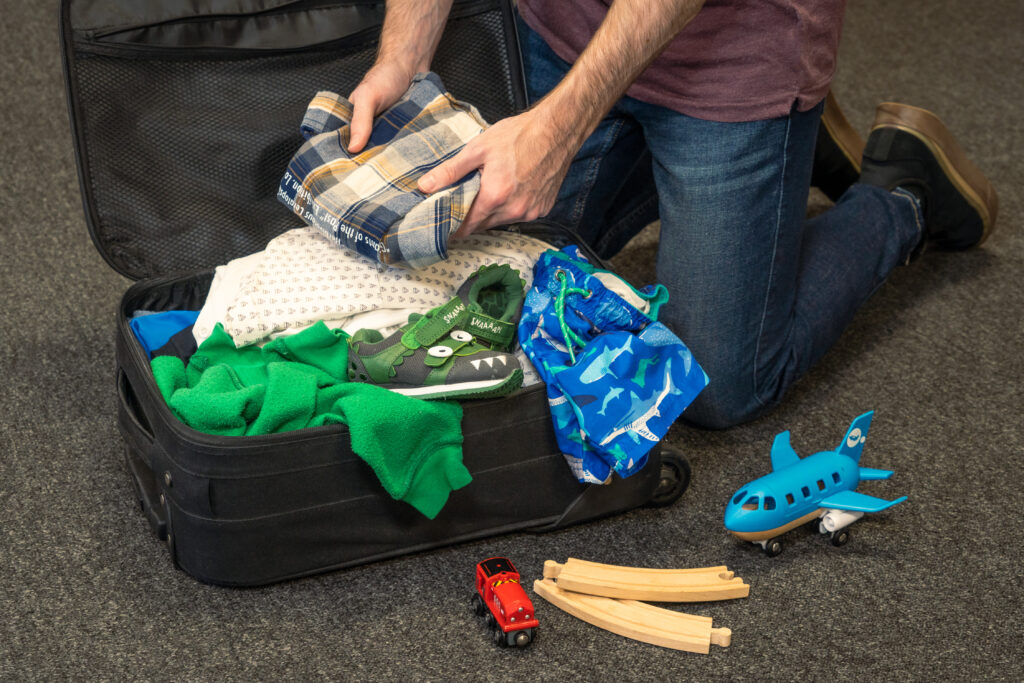
Quick answer: For a seven-day trip, start with your booked fare’s baggage allowance, then plan clothes around one confirmed laundry opportunity. Measure your packed bags, check any weight limit, and keep medication and flight essentials in your personal item. The sample lists below are planning suggestions—not guaranteed fits.
Scope: U.S. airport departures, a mild-weather city trip, and Delta-operated flights as the airline example. For international trips, check security and medication rules for your connections and return journey too. Airline policies checked October 6, 2026.
1. Check your fare before choosing a bag
A useful packing list begins with a baggage allowance, not a suitcase purchase. Open your reservation and record:
- The airline operating each flight.
- Your fare and any purchased baggage allowance.
- The permitted number of bags.
- Maximum dimensions for each bag.
- Any individual or combined weight limit.
For the Delta example, the published allowance is one carry-on and one personal item free. The carry-on limit is 22 × 14 × 9 inches, including handles and wheels, with a maximum combined measurement of 45 linear inches. The personal item must fit beneath the seat; the page does not publish a universal numerical size or general weight cap. Partner airlines may have different restrictions. (delta.com)
Do not read “no published weight cap” as permission to pack an unmanageable bag. Choose a load you can handle independently.
If your actual fare permits only a personal item, use that smaller allowance as your starting point. Cut optional items or compare the price of adding a cabin bag before committing to a packing plan.
Practical check: Save the relevant policy and your booking allowance offline. Recheck them before departure rather than relying on an old packing guide.
2. Decide how laundry and weather change the list
Before selecting clothes, answer three questions:
- What conditions should I prepare for?
- Which activities require different clothing or footwear?
- Where and when will I wash clothes?
For this article’s example, assume seven calendar days, everyday sightseeing, mild conditions, no formal event, and laundry after day four.
Confirm what “laundry available” actually means. Ask your accommodation about machines, opening hours, payment, detergent, drying facilities and service turnaround. A laundry service returning clothes after checkout does not help your plan.
Use this simple approach:
Pack enough fresh clothing to reach laundry day, plus what you will wear while the load is washing and drying.
Avoid a plan that depends on every washed item being ready immediately. Leave one clean outfit outside the laundry load.
Then adjust deliberately:
| Trip condition | Suggested change |
|---|---|
| Hot weather or strenuous activity | Allow more fresh tops or arrange earlier laundry |
| Cooler evenings | Add a layer that works with the same outfits |
| Rain expected | Include suitable outerwear and review footwear |
| Formal meal or event | Substitute one appropriate outfit rather than adding several |
| No dependable laundry | Increase fresh underwear, socks and tops as needed, then test the bag again |
These are planning choices, not a universal clothing formula. Comfort, hygiene, accessibility needs and personal preferences come before minimizing the item count.
3. Use this mild-weather city packing list
The following list is an illustrative starting point for one adult. It includes clothing worn on departure, so do not accidentally pack those items again.
| Category | Wear on departure | Pack |
|---|---|---|
| Tops | One everyday top | Three interchangeable tops |
| Bottoms | One pair of trousers | One other pair of trousers, skirt or equivalent |
| Layers | One sweater or light jacket | One rain layer if conditions warrant |
| Underwear | One set | Four sets |
| Socks | One pair | Four pairs, if your footwear requires them |
| Sleepwear | — | One set |
| Shoes | Comfortable walking shoes | A second pair only for a specific need |
| Accessories | As needed | Essential hat, glasses or other personal items |
Choose combinations before packing: each top should work with both bottoms. If an item creates a new requirement—different shoes, a special belt or another layer—decide whether that outfit justifies the extra space.
Add these non-clothing essentials:
- Travel documents and payment methods.
- Medication and necessary medical supplies.
- Phone, charging cable and suitable wall charger.
- A plug adapter if required by the destination.
- A compact toiletry kit.
- Glasses, contact-lens supplies and personal hygiene items as needed.
- A separate bag for dirty clothes.
- One small activity item, such as a book or headphones.
Worked example: Wear top A on day one, then tops B, C and D on days two through four. After day four, wash those tops and the used underwear and socks while keeping your laundry outfit available. If everything is ready for day five, reuse clean tops through day seven.
This example depends on successful laundry and your willingness to rewear suitable clothing. It does not establish that the list fits every cabin bag. Pack it, close the bag normally and measure it.
4. Change the plan for a family traveling with a child
For a family example, assume two adults and one toilet-trained, school-age child, each with a ticket whose allowance has been checked. Keep the adult lists as a starting point, but give the child a larger clothing buffer.
Suggested child list, including departure clothing:
- Five everyday tops.
- Three bottoms.
- Six sets of underwear.
- Six pairs of socks, if needed.
- One set of sleepwear.
- One warm layer.
- Rainwear if appropriate.
- Walking shoes, plus other footwear only when necessary.
- One small comfort item and compact entertainment.
Keep a complete child outfit and a spare adult top in an adult’s personal item. Allocate shared toiletries and chargers before packing so both adults do not unknowingly carry duplicates. Adults should retain responsibility for documents, medication and essential supplies.
For an infant or toddler, replace this list with a care-specific plan: diapers or toileting supplies, wipes, feeding equipment, additional clothing changes and any necessary cooling arrangements. Confirm destination availability before depending on local purchases.
On Delta, children traveling free do not receive a separate baggage allowance. Strollers and child-restraint seats can be checked without a fee and do not count toward the baggage allowance; this does not guarantee cabin storage. (delta.com)
U.S. screening exceptions cover formula, breast milk, toddler drinks and baby/toddler food. Declare qualifying items at the start of screening. CDC also advises separating expressed milk and related accessories from ordinary liquids and allowing extra screening time. (tsa.gov)
A liquids exception is not an extra airline bag allowance. Check both sets of rules.

5. Make toiletries fit the security rules
For ordinary liquids, gels and aerosols at U.S. TSA checkpoints, use containers holding no more than 3.4 ounces/100 milliliters, all fitting in one clear, quart-size, zip-top bag per passenger. Creams and pastes also fall within the liquids rule. (tsa.gov)
The container’s capacity matters: do not assume a nearly empty oversized bottle qualifies. (delta.com)
Build the toiletry kit from actual needs:
- Toothbrush and toothpaste.
- Deodorant.
- Required hair and skin products.
- Sunscreen appropriate to your plans.
- Contact-lens products, if used.
- Personal hygiene supplies.
Test the liquids bag before departure. If it will not close, remove optional products, use appropriately sized containers or confirm which products you can obtain at your destination.
Ask the accommodation what it supplies rather than assuming shampoo or other toiletries will be available. Keep medically necessary products out of the “optional” category.
For international travel, verify rules at every airport where you will pass through security, including connections. Duty-free liquid purchases can require separate checks when another screening checkpoint is involved. (delta.com)
6. Keep batteries and medication accessible
Pack electronics around what you actually need. Consider whether a phone can replace an optional laptop, camera or tablet, but do not remove equipment required for communication or accessibility.
Spare lithium batteries and power banks must stay in the cabin. Protect them against damage and short circuits, and remove them before any bag is gate-checked. Damaged, defective or recalled lithium batteries and devices must not travel. (faa.gov)
For the Delta example, the current power-bank policy permits no more than two per person, each no greater than 100 Wh. It prohibits overhead-bin storage and recharging the power bank onboard. Using one to charge a device is prohibited during taxi, takeoff and landing. (delta.com)
Read the battery’s label rather than guessing its capacity. If only voltage and milliamp-hours are given, FAA’s calculation is:
Wh = volts × (mAh ÷ 1,000). (faa.gov)
Keep medication in your personal item. CDC recommends original labeled containers, prescription copies, and enough medicine for the trip plus extra for delays. Check medication permissions with destination and transit-country authorities; U.S. legality does not establish legality abroad. (wwwnc.cdc.gov)
TSA allows larger amounts of medically necessary liquids in reasonable quantities for the trip, but they must be declared for inspection. Do not shrink or omit medication merely to fit the ordinary liquids bag. (tsa.gov)
7. Prepare for your cabin bag to be checked
Carry-on allowance does not guarantee overhead space. Delta warns that bags may be gate-checked on full flights or where aircraft storage is limited. (delta.com)
Organize your luggage into two groups:
Personal item: documents, payment methods, medication, accessible batteries, essential electronics, glasses, child care essentials and a clothing change where needed.
Main cabin bag: most clothing, nonessential accessories and items you can manage without during the flight.
Keep spare batteries and power banks easy to reach so they can remain with you if the larger bag is taken for checking. (faa.gov)
If avoiding any hold baggage is essential, do not rely on an overhead suitcase alone. Confirm the aircraft restrictions and consider whether your necessities can fit within the permitted personal item.
8. Run a final packed-bag check
Do this with the actual bags you will take—not just the packing list:
- Count: Does your arrangement match the booking allowance? Consolidate any extra handbag or pouch unless a verified exception applies.
- Measure: Check the packed exterior, including protruding pockets, handles and wheels.
- Weigh: Check any applicable individual or combined limit.
- Handle: Walk with the bags and test whether you can lift and move them comfortably.
- Screen: Make liquids and declared exceptions accessible.
- Label: Read power-bank capacity markings and retain medication labels.
- Reconfirm: Check laundry arrangements and the destination forecast.
- Investigate: Verify unusual items individually with the airline and relevant security authority.
Common mistakes are packing seven unrelated outfits, overlooking laundry turnaround, counting departure clothes twice, and assuming another airline’s rules apply. Avoid compressing clothes so aggressively that you miss an applicable weight limit.
The goal is not the smallest possible bag. It is a manageable, compliant load that covers your actual trip—with enough flexibility for laundry delays, changing conditions and family needs.