Quick answer
Stay car-free for a Florence-based week focused on cities such as Pisa and Lucca. Consider a rental car for a countryside stay with several village visits. Tuscany’s official tourism guidance distinguishes its rail-connected cities from hill towns such as Pienza and San Gimignano, which require an additional road connection. For a mixed trip, use trains during the city portion and price a shorter rental for the rural portion. That recommendation follows the route coverage—not a claim that either option is always cheaper. (visittuscany.com)
This guide assumes a seven-day leisure trip. The examples use two adults paying adult fares; the driving example assumes one US-licensed driver aged 30 who is comfortable driving abroad. Budget comparisons are in euros and exclude accommodation, meals, flights and attraction admission unless those costs change with the transport choice.
Official information checked October 6, 2026. Recheck schedules, restrictions and rental conditions for your travel dates.
1. Choose your accommodation and outings before choosing transport
Start with the addresses where you will sleep and the places you genuinely want to visit. “A week in Tuscany” is not specific enough to decide whether you need a car.
Florence’s Santa Maria Novella station is centrally located, and the regional tourism authority identifies direct rail connections from Florence to Pisa and Lucca, among other destinations. It also warns that numerous hill towns are not directly accessible by train. (visittuscany.com)
Use this decision table as a planning recommendation:
| Your intended trip | Transport to investigate first | Deciding check |
|---|---|---|
| Florence accommodation, museums and city excursions | Train and local public transport | Can you comfortably reach the station and your sights? |
| Rural accommodation, village visits and meals away from the property | Rental car | Is there a workable alternative for every outward and return journey? |
| Florence followed by a countryside stay | Train, then a shorter rental | Do pickup and return arrangements fit the change of base? |
| City sightseeing plus one countryside outing | Train plus a separately arranged excursion or transfer | Does that outing justify keeping a car for the whole week? |
For families, compare actual fares for each child rather than multiplying an adult fare. For solo travelers, calculate the entire car cost against one rail fare. If anyone has limited mobility, assess station access, boarding assistance and the route from arrival point to attraction; neither transport choice automatically solves those needs.
2. Work through Florence–Pisa–Lucca as a rail trip
Trenitalia’s Tuscany Line serves Florence, Pisa and Lucca. The route therefore offers a useful test of whether a car would add enough convenience to justify its costs and responsibilities. (trenitalia.com)
Worked example: two adults based in Florence, traveling without overnight luggage.
- Search Firenze S. M. Novella to Pisa Centrale. Choose an arrival that leaves room for the transfer to your first sight. As one published timetable example, RFI lists a service leaving Florence at 08:28 and reaching Pisa Centrale at 09:32—a 64-minute rail journey. This is an example from the timetable valid June 14–December 12, 2026, not a promise that it operates on your chosen date. (prm.rfi.it)
- Plan Pisa Centrale to Piazza dei Miracoli separately. Do not treat arrival at the station as arrival at the Leaning Tower. The University of Pisa’s Botanical Garden directions identify bus line 1+ from Pisa Centrale toward the Piazza dei Miracoli area. Check the operator’s current stop and timetable information before traveling. (ortomuseobot.sma.unipi.it)
- Visit Pisa, then leave a proper lunch break. Put any timed admission into the plan before choosing the onward train.
- Search Pisa Centrale to Lucca after your Pisa visit. RFI’s published timetable includes a 09:22–09:50 service, illustrating a 28-minute journey on that particular departure. Use the duration of your actual afternoon train—not this morning example—when building your day. (prm.rfi.it)
- Walk into Lucca and return to Florence on a checked service. Lucca’s municipal tourism site places the station approximately 350 meters from Porta San Pietro, an entrance to the historic center. Verify the Florence return before leaving in the morning and keep an earlier departure available as a fallback. (turismo.lucca.it)
This loop is a sensible option if you want a selective visit to both cities. If you want extensive monument visits in Pisa and an unhurried afternoon in Lucca, split them across two days. Do not compress the sightseeing simply because the stations connect.
For the rail budget, record all three fares for both adults, then add any buses or taxis. For the driving alternative, include rental collection, two parking arrangements and the walk from each parking place—not just road travel.

3. Test a countryside stay against its actual road connections
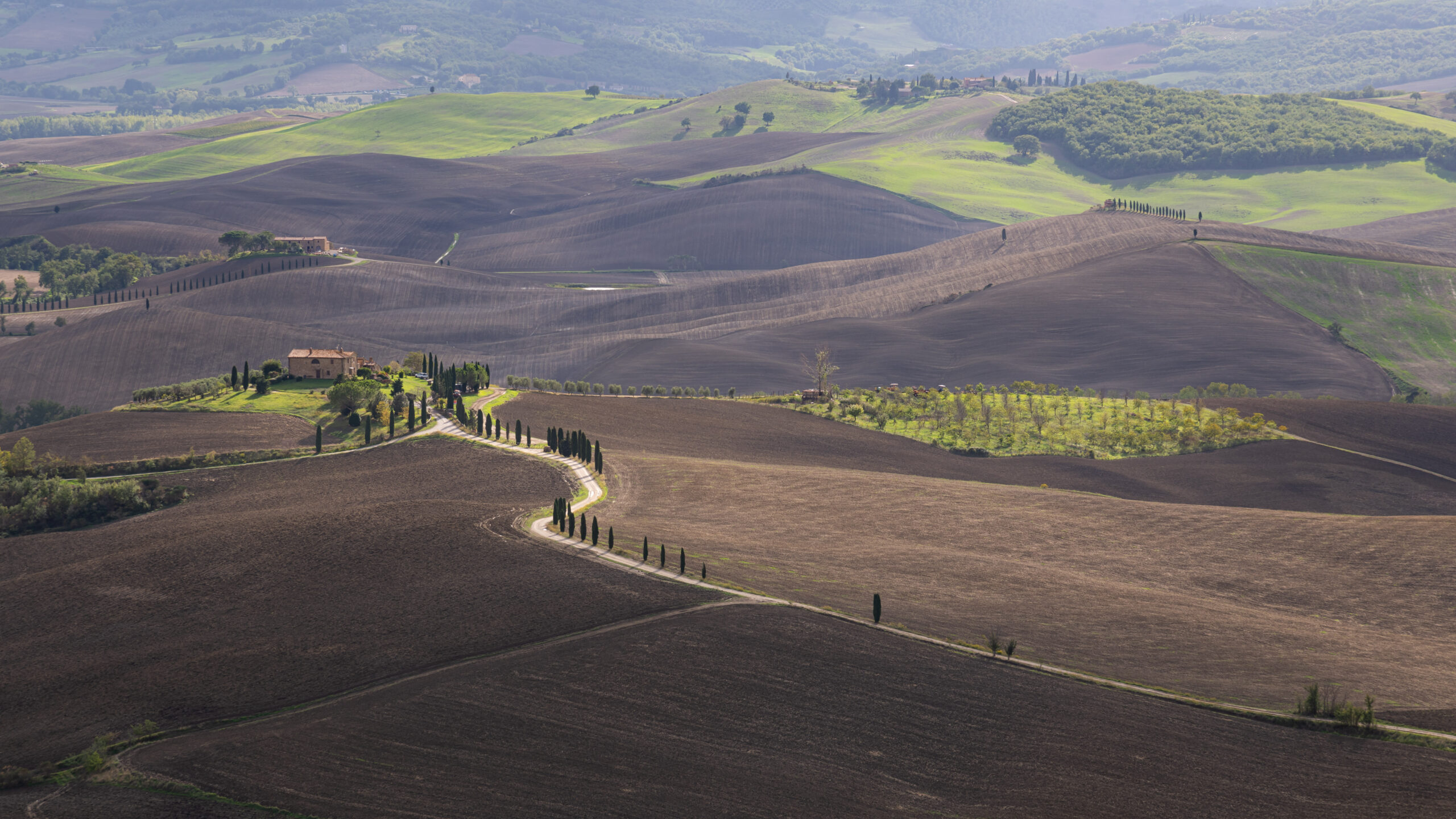
Now change the trip: the same couple spends part of the week at rural accommodation near Pienza, with outings to Pienza and Montepulciano.
Pienza is among the hill towns that Visit Tuscany identifies as not directly accessible by train. Montepulciano’s official destination guidance recommends exploring its historic center on foot, following the street uphill from Porta al Prato toward Piazza Grande. A car may help you reach the town, but it does not eliminate the walking within it. (visittuscany.com)
Before booking the accommodation, ask the host for:
- The precise arrival address and recommended access route.
- Whether parking is available and included.
- Any access restrictions affecting guests.
- The nearest usable public-transport stop.
- Whether transfers can be arranged, at what price and with what notice.
- How you would reach dinner and return afterward.
Then test this proposed rural portion:
| Part of the stay | Plan to check |
|---|---|
| Transfer from Florence | Rental pickup hours, legal exit route and accommodation arrival arrangements |
| Pienza outing | Visitor parking, access restrictions and the walk into town |
| Montepulciano outing | Parking location, uphill walking and a suitable return route |
| Quiet day at the property | Whether groceries and meals require another journey |
| Departure | Refueling, return inspection and onward connection |
My recommendation: favor a car if the checked public-transport and transfer options do not support the outings you want. If driving is not suitable, change the accommodation or simplify the itinerary before paying nonrefundable deposits.
For wine-related outings, arrange a driver who will not drink or book transport separately. Do not make the return journey depend on an unconfirmed taxi.
.jpg)
4. Treat restricted zones and parking as separate decisions
A ZTL—zona a traffico limitato—is a restricted traffic zone, not a parking charge you can simply pay upon arrival.
Florence’s official visitor guidance says much of the historic center is within a camera-monitored ZTL. It separately prohibits private traffic in pedestrian areas and bus lanes. Consequently, permission to enter one part of the city does not mean every street is usable. (feelflorence.it)
If your Florence hotel or garage is inside the ZTL:
- Contact it before driving.
- Obtain the recommended entry and exit route.
- Ask exactly how your rental vehicle’s registration will be submitted.
- Confirm what access that procedure covers.
- Follow signs and the authorized route rather than an unchecked navigation suggestion.
Florence’s guidance describes hotel and garage registration procedures, but these should not be interpreted as unrestricted driving permission. (feelflorence.it)
Lucca presents a similar planning issue: most of its historic center is a ZTL, while parking around the walls can be paid or subject to a parking-disc requirement. Its municipal tourism site provides a parking-map reference. (turismo.lucca.it)
For each stop, write down where you may drive, where you may park and how you will reach the sight afterward. Also ask a downtown rental branch for its legal departure and return routes.
5. Check driver eligibility and rental conditions before comparing prices
For the example’s US-licensed visitor, Italian road law generally requires the valid national license together with an International Driving Permit or an official Italian translation, subject to applicable international conventions. Obtain the appropriate documents before departure; a rental desk accepting a booking does not establish legal driving eligibility. (aci.gov.it)
Check the supplier’s requirements separately. Europcar’s published document guidance, for example, requires physical documents and a qualifying payment card in the main driver’s name; additional drivers also need their documents. Card acceptance must be checked for the rental country and vehicle category. (europcar.it)
Before paying, confirm:
- Eligibility: age, license history and permitted vehicle category.
- Vehicle: transmission, passenger space and luggage capacity.
- Price: taxes, location charges, additional-driver fees and equipment.
- Mileage and return: allowance, one-way charges and branch opening hours.
- Protection: damage and theft excesses, exclusions and roadside assistance.
- Fuel: return requirements and potential refueling charges.
- Changes: cancellation, late pickup and late return conditions.
These are contract checks, not assumptions about every supplier. Europcar’s Italy terms illustrate age-related restrictions, fuel policies and charges associated with traffic violations. Its handling charge for a violation is separate from the authority’s fine. (static.europcar.com)
At pickup and return, photograph the vehicle and retain the condition records. Ask staff to record discrepancies before signing.
6. Compare whole-trip costs, not a daily rental headline
Without travel dates, a vehicle quote and selected trains, there is no defensible exact total. Use a worksheet instead of relying on an undated “typical cost.”
| Rail and local transport | Rental car |
|---|---|
| Every traveler’s rail fares | Quoted rental total, including mandatory charges |
| Station-to-sight buses or taxis | Fuel or charging |
| Accommodation transfers | Road tolls |
| Any luggage-storage expense | Parking at accommodation and attractions |
| A realistic fallback transfer | Equipment, additional drivers and one-way charges where applicable |
Keep the security deposit outside the spending total, but allow enough available funds for it. Europcar’s deposit policy distinguishes the security authorization from rental charges and explains that additional rental amounts may also be authorized when the booking has not been prepaid. Confirm your own supplier’s amount and release conditions. (europcar.com)
Worked fare calculation for the city loop
Let:
- A = one adult fare, Florence to Pisa;
- B = one adult fare, Pisa to Lucca;
- C = one adult fare, Lucca to Florence;
- L = combined local transport for both adults.
The couple’s transport total is:
2 × (A + B + C) + L
This counts six passenger rail journeys. Enter the fares returned for the selected services; no unverified fare amounts are needed.
If you split Pisa and Lucca into separate day trips, price all four legs per adult. Do not assume reverse-direction prices or available services are identical.
For the rural portion, compare the complete rental quote plus operating costs with confirmed public transport and transfer prices. A seven-day rental and a shorter rental are separate quotes: do not calculate one by proportionally reducing the other.
7. Make these final checks before booking
Avoid three common mistakes: choosing a remote property before checking access, confusing rail time with door-to-door time, and treating a rental booking as permission to enter historic centers.
Use this final checklist:
- Route: Search exact stations and accommodation addresses.
- Schedule: Check outward, onward and return services for the correct date.
- Disruption: Recheck official notices shortly before travel.
- Access: Identify station transfers, parking walks and any assistance requirements.
- Driving: Obtain documents and written branch access instructions.
- Budget: Compare the same party, dates and inclusions.
- Fallback: Decide what to skip if a connection or attraction becomes unavailable.
Check ticket rules too. Trenitalia currently states that its Digital Regional Ticket activates automatically at the selected train’s scheduled departure. Paper regional tickets require validation; follow the conditions for the ticket type actually purchased rather than an old online guide. (trenitalia.com)
The practical choice is to match transport to each part of the holiday: start with trains for a Florence-based city itinerary; investigate a car when rural accommodation and village visits create road journeys that public transport cannot conveniently cover. You do not have to make one transport choice for the entire week.